
German Shepherd Stud Service at
How we approach responsible breeding — HD/ED thresholds, DNA testing, pedigree compatibility, and a fully documented record of every pairing we've made.
✎ Marius Ciprian · Casa Arancina · Updated: May 2026
OUR APPROACH
What "responsible breeding" means for us
A mating isn't a single moment — it's a decision whose effects play out in every puppy it produces: their structure, their joints, their temperament, the drives they're born carrying. Get it wrong, and that mistake follows dozens of dogs for years.
Nothing goes forward at Casa Arancina until we've run the numbers on a pairing first: inbreeding coefficient, both parents' HD/ED results, titles earned, how the line has held up over time, and whether temperaments are compatible. A male isn't chosen for being good-looking or simply on hand — he's chosen because the data backs it up.
We work alongside breeders and kennels across Germany and other parts of Europe with a real track record in German Shepherd selection. That network gives us access to bloodlines with genuine, verifiable international results — not names pulled from a catalog, but connections built over years inside the breed.
WHAT WE REQUIRE
Our non-negotiables when choosing a breeding dog
Before any male is paired with one of our females, every item on this list has to check out — no exceptions.
German-validated HD/ED clearances
Hip dysplasia (HD) and elbow dysplasia (ED) are checked by X-ray and read by SV Germany-accredited evaluators. Only A or B results are accepted — anything less, and the male is out of consideration entirely.
A registered DNA profile
DNA testing confirms exactly which dog is which, ruling out any pedigree mix-ups. It's officially logged and attached to the paperwork for every mating we carry out.
Working and conformation results
Every male we use has cleared at least one formal test — Wesentest, BH, or an IGP title — under an SV- or FCI-approved judge.
A checked inbreeding coefficient
We run the coefficient of inbreeding on any proposed pair before committing to it. The higher that number, the greater the odds of recessive conditions surfacing — so we aim as low as the pedigree allows.
OUR STUD
Pako — Our Kennel's Active Stud Dog
Pako was raised, trained and evaluated right here at Casa Arancina. He descends from SV Germany bloodlines, carries a genuine FCI pedigree, and holds validated HD/ED clearances plus a registered DNA profile.
We didn't just take his temperament on paper — it's been formally tested and watched in real working conditions, which matters to us as much as any certificate. A dog that can't hold his composure under pressure doesn't get used for breeding, pedigree or no pedigree.
Pako
Male · SV Germany bloodline
- ✦Genuine FCI pedigree
- ✦HD/ED clearances validated
- ✦DNA profile officially registered
- ✦Breeding rights confirmed
A DOCUMENTED RECORD
Every mating we've done, on record
We log every mating at Casa Arancina — when it happened, which dogs were paired, and, where relevant, what came of it. Keeping that record open is part of how we hold ourselves accountable to the breed.

September 2, 2022
Athos von Haus Emy × kennel female
March 26, 2023
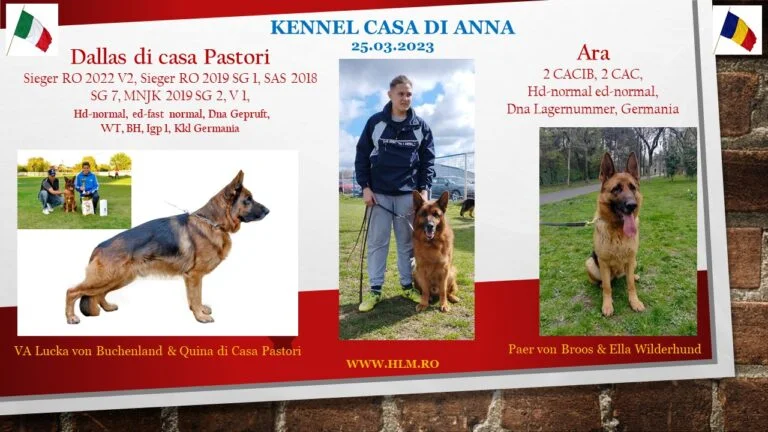
Dallas di Casa Pastori × kennel female
September 30, 2023
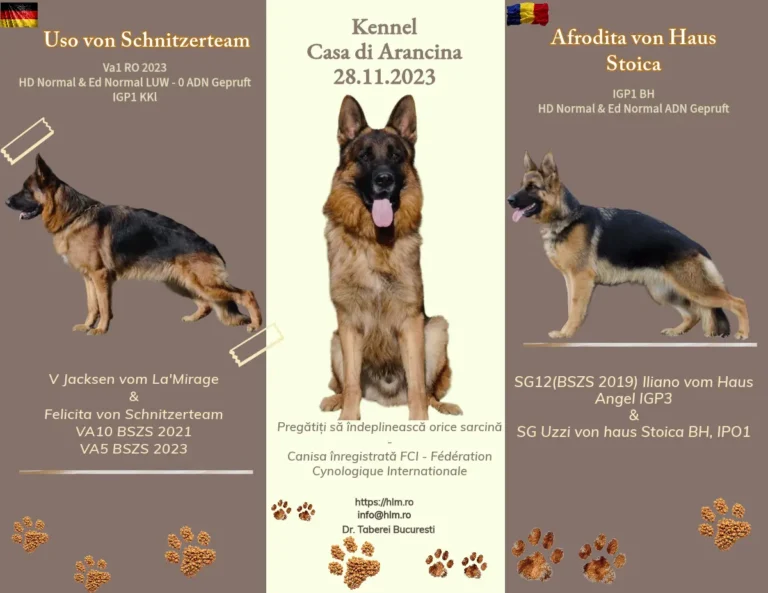
Uso von Schnizerteam × Afrodita von Haus Stoica
Every date and pairing shown here comes straight from our official mating records.
THE PROCESS
What actually happens, step by step
The groundwork for a good mating starts weeks ahead of time, not on the day itself. Every stage matters.
Progesterone testing
This test pinpoints the actual fertile window rather than relying on a calendar guess. We treat it as non-negotiable — it cuts the odds of a failed mating dramatically — and it's run by our vet a few days before the planned date.
The mating itself
It happens in a calm, controlled setting, with both dogs relaxed and somewhere familiar. We log the exact date and circumstances, and repeat the mating after 48 hours if that improves the odds.
Confirming and monitoring the pregnancy
Around 25–28 days later, an ultrasound confirms pregnancy. From that point until whelping, we adjust the female's diet, activity level and veterinary checks, and keep records throughout for the litter's official pedigree.
STUD SERVICE FAQ
Questions we get about stud service
What paperwork should a German Shepherd stud dog have?
Why is the progesterone test mandatory?
How do you calculate the inbreeding coefficient, and why bother?
What's the difference between HD A and HD B?
How many litters is a German Shepherd female allowed to have?
How long does a German Shepherd pregnancy last?
KEEP EXPLORING
Have more questions about breeding or stud selection?
German Shepherd Males
Pako — pedigree, certificates and results, all in one profile.
German Shepherd males Casa ArancinaGerman Shepherd Puppies
What proper documentation looks like and how we raise a puppy responsibly.
German Shepherd puppies with FCI pedigreeThe German Shepherd Breed
Our full guide — history, FCI Standard No. 166, temperament and selection.
German Shepherd breed complete guideCONTACT
Reach out by message or call
Advice on breeding selection costs nothing and comes with no strings attached.